Solo project · product design and software engineering · Snapshot · As of October 2026
Resonova Radio
An Android music radio app with AI hosts. Between songs, hosts talk about your own city, weather and local news; real local stories become a running story as you listen.
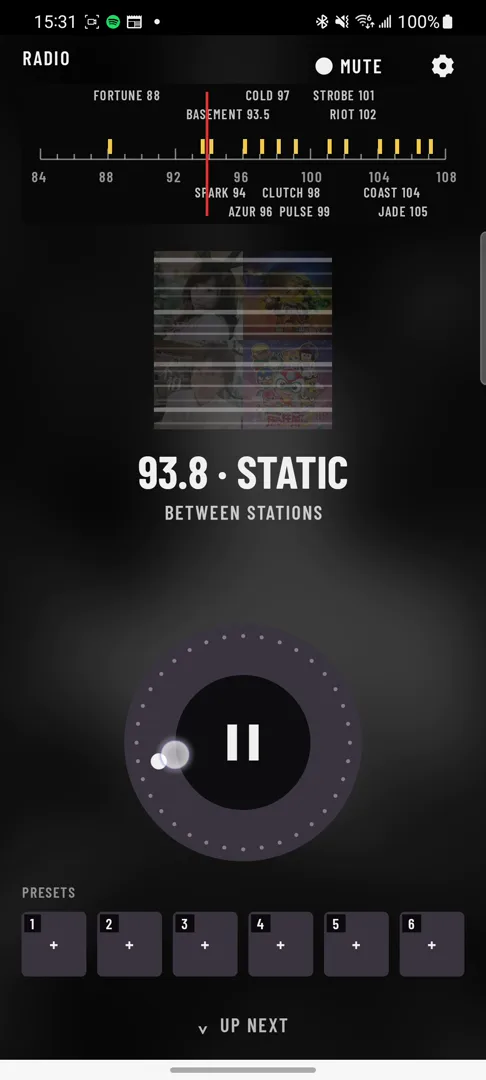
Tune to a station and keep listening. Hosts talk over song openings and endings, and in the breaks. Changing station changes the music and the person in the booth, while programmes follow your city, weather and local news.
Music can come from Spotify playlists or audio folders on the server. Folders are configured server-side today; there is no finished in-app upload flow.
What I built
My scope: product and interaction design, the Kotlin Android client, the Python service and integration validation. A private test version. The separate Resonova Cast makes saved, replayable shows with two hosts; Radio organises content around ongoing stations.
About 75 seconds on a phone, sound on: tuning to Strobe 101, speech over a song's start and end, then marking a line I liked. This records the test build used at the time.02
How it works
The server's station engine decides what airs: the song, where speech can go, and when a break contains an ad or news. Background workers prepare finished recordings. The phone executes the plan and reports what happened.
Library and state
Read Spotify or file libraries; keep each station's music round, queue and position.
Broadcast choices
The engine places items and speech windows. Workers prepare speech in order of when it will be needed.
Phone playback
Native logic coordinates Spotify songs, file songs and speech through their respective players.
Playback reports
Record completion, failure or skipping. The server checks item numbers and identity before updating state.
A station moves on while you are away; pause keeps your place
On return, the server works out the station's position from the time away, so you can join halfway through a song. It does not need to render an unheard audio stream continuously. An explicit pause keeps the place until you tune elsewhere. Accounts keep their own progress; this is not one live stream shared by every listener.
A city that can change without keeping stale news on air
Your city, local weather and ongoing local stories provide shared context across stations. Continuing stories advance with saved listening progress. Bulletins depend on story versions: when a version changes, old bulletins become ineligible. Items that passed while the listener was away are not counted as heard and do not advance the stories.
This constrains consistency; it does not guarantee that generated writing is correct or natural. Making the city's running stories more noticeable in actual listening remains open work.
03
Engineering challenges
Model latency must not become the playback clock
Writing and speech synthesis have variable latency. The maker reads the engine's predicted needs, prepares the earliest ones first and stores finished audio. Broadcast choices use ready, eligible recordings. If optional host speech is not ready, a song can still play rather than wait for a model call.
Preparing ahead has costs and quota limits. It does not remove delays from downloads or Spotify, and a new station needs setup time.
Coordinate two audio sources on Android
Spotify songs play in the separate Spotify app; Media3 plays speech and server-hosted songs. Radio's native playback state machine handles start, pause, song positions and voice timing. The UI displays state rather than advancing the programme. A foreground playback service owns the running logic for background and lock-screen listening.
Speech may overlap a song's opening or ending, or play as a separate break. Late position reports, playback failures and a listener choosing a different song in Spotify all need explicit handling. Sending a play command is not proof that a song started.
A retry must not advance the programme twice
The phone saves a pending playback report before sending it. Reports survive a lost connection and are retried afterwards. The server recognises repeated item numbers and identities rather than applying the same result again. Failed, skipped and passed-while-away items are recorded separately.
A short queue is fetched ahead, so an interrupted connection can leave some content available. When the queue runs out, the player stops and explains why. This is bounded buffering and recovery, not full offline radio.
Implementation evidence and verification limits
Source inspected: resonova-radio 4d82070, 16 October 2026. These mechanisms exist in code; this is not a guarantee about the deployed revision or every phone.
radio/station/engine.py: catch-up, numbered queues and report deduplication. news.py and airing.py: story versions and eligibility.
recording_maker.py: generation by predicted deadline. RadioPlayer.kt: playback state and pending reports. RadioService.kt: foreground service.
Existing automatic checks cover repeated requests, deduplication across restarts, catch-up versus pause and generation demand order. They do not establish listening quality or every background scenario.
The client saves the result before attempting to send it:
The video and screenshots show interaction on particular builds. Deployment freshness, extended listening and device coverage need separate verification.
04
Design decisions
Tuning has to work under a thumb
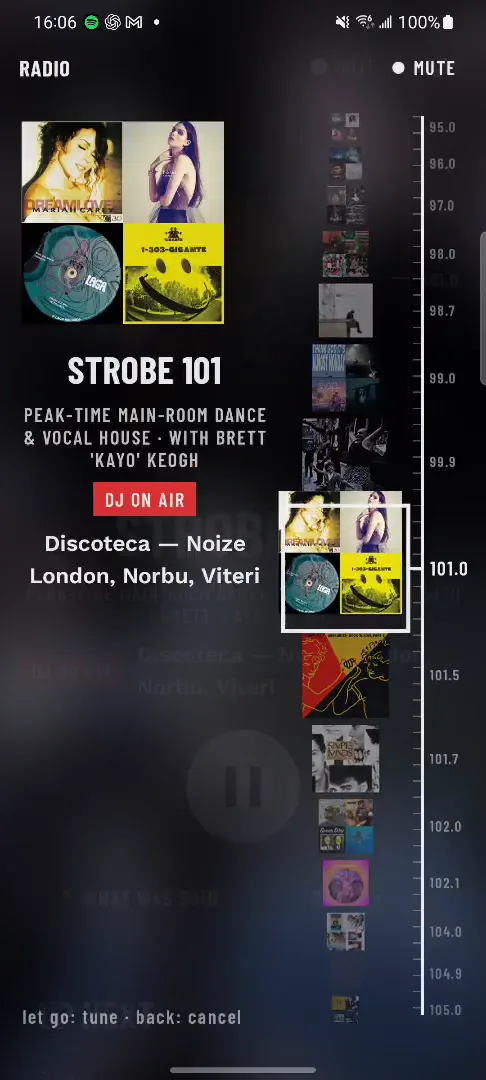
The early knob conflicted with page scrolling and could stop between stations. After fixing those details, I still removed it. Holding the cover, sliding to a station and releasing to tune was simpler in the hand. The decision came from using a phone build, not the appearance of the design file.
Earlier knob: conflicts with scrolling and can stop between stations.Hold and slide: release to tune to the selected station.
Recover the line that just went by
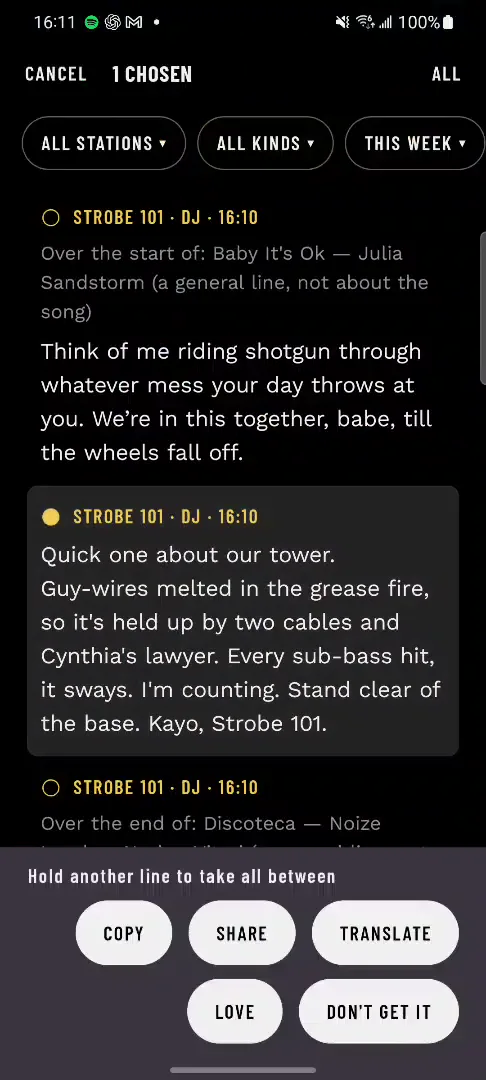
What was said keeps spoken text available to read, copy, share and mark. Listeners can say why a line was not understood: unclear delivery, an unfamiliar word or name, disconnected sentences, or understood but not funny.
Feedback is stored against the line. Unclear host speech can be tried again with the same words and slower delivery; content problems retire a line and enter a rewriting path. Some generation paths use liked and misunderstood lines as examples. This is not model training, and improved long-term preference matching has not been demonstrated.
Spoken history and feedback on the test build recorded at the time.
Design research: broadcast rhythm, references and writing experiments
One design reference was the radio in GTA V. I analysed recordings of songs, host speech, ads, news and station IDs, comparing two annotation passes to study broadcast rhythm. The observations informed starting rules; familiarity with the game is not needed to understand or use Resonova.
0 min5 min10 min
Song
DJ talking
News
Station jingle
Research reference: an annotated excerpt from a Los Santos Rock Radio recording. This describes the reference material, not a measured result for Resonova.
I also ran small writing-recognition exercises. In one set on 15 October 2026, I attributed 11 of 13 reference lines and 11 of 13 generated lines to the reference source. This was an author-run creative experiment, not independent audience research. It does not establish equivalent audio quality or show that ordinary listeners cannot distinguish the two.
The research helps propose and revise creative hypotheses. Usability, entertainment quality and software reliability require separate evidence.
05
Current state
As of 16 October 2026, Radio is a private Android test app with server-side scheduling and background content generation. Implemented flows include tuning, Radio / Shuffle / In order modes, host speech, ads and news, spoken history and feedback. Spotify and server-hosted songs use different playback paths.
Inspectable evidence: the phone recording and screenshots here, the v0.9 APK release record, and the specific code and automatic checks above. The release is a historical snapshot, not an APK containing every later change.
Still being improved: repetitive writing over long listening sessions, voice performance and how clearly the running city stories come through on air. There is no independent listener study establishing entertainment quality.
Known playback limitations: a Spotify Free account can remain silent while the UI shows playback. Switching Spotify accounts can leave owned audio using an old key until an app restart. Server and network availability remain dependencies; this is not evidence of a dependable 24/7 service.
Unfinished: continuous-mix and talk-radio stations, and a complete listener-facing upload and management flow for server song folders.
Product, interaction design and engineering: Pengyu Jie. Kotlin / Android / Media3 · Python / FastAPI · Spotify · LLM writing and Gemini TTS. Cast is a separate product with its own engineering note.